Showing posts with label JRR Tolkien. Show all posts

Tuesday, February 24, 2015

New Year's Resolution

Yes, I know. It's the end of February and New Year's was several weeks ago. And a post about a New Year's resolution on a blog about books doesn't make much sense. Well, in a few minutes it will. Sometime between finishing The Fellowship of the Ring and starting The Two Towers, I made a decision. I decided that from now on, I will read at least one book by J.R.R. Tolkien a year. Notice I said "at least one". I think it's safe to say that I'm likely to read more than one since I adore him so much. But I'm going to make a conscious effort to read at least one of his works. And then today I thought, why not expand that resolution and include other authors?

What follows is a list of authors or time periods that I will read one book of each year. Realistically, this is a serious time commitment that I am making. I have 7 different categories that I've settled upon. That equals at least 7 different novels. And while that may not seem like a lot, these are novels I'm talking about, not children's books. Some of them will take longer to read because of how they are written or how long they are. So what could seem like a small number of novels can quickly stretch over a year.

One (1) J.R.R. Tolkien novel
This is anything from The Lord of the Rings to one of the books in the 12 volume History of Middle-earth series to his translation of Beowulf. There are many novels to choose from by Tolkien, whether they were published in his lifetime or have been published posthumously.

One (1) Robin McKinley novel
McKinley is possibly my favorite author after Tolkien. The Blue Sword is one of my favorite books and both Deerskin and Sunshine could arguably be added to that list. I already reread her books quite often so she clearly belongs on this list.

One (1) Agatha Christie novel
I'm not quite sure what it is about Christie, but I love her books. Sometimes you just need a good mystery and she has so many to choose from. Plus, I find Hercule Poirot and Miss Marple to both be very adorable.

One (1) William Shakespeare play
Yes, this category is technically plays and not novels. However, I am quite fond of a few of his plays and I do want to read the rest. Therefore, I'm putting him on this list regardless of what format he wrote in.

One (1) Jane Austen or Bronte novel
I made this a combined category because I love Austen and I love Charlotte Bronte. However, I haven't read all of Austen's novels nor have I read everything by the Bronte sisters. Did you know there were 3 Bronte sisters and they were all authors? Wuthering Heights and Jane Eyre are both Bronte novels. As all four women wrote in a similar style and about similar subjects, I figured they could be in a category together.

One (1) Victorian novel
My favorite time period for literature is Victorian. It was when the novel really became popular and it includes several great authors. Some of the most popular authors include Charles Dickens, William Thackeray, George Eliot, Thomas Hardy, Bram Stoker, Arthur Conan Doyle, and Elizabeth Gaskell. They all have novels I've been meaning to read and just haven't had the time to.

One (1) 20th Century American novel
I prefer English literature over American as a general rule. However, there are several American authors who have novels that I want to read. So this is much more of a specific category than the Victorian one. The authors I intend to read in this category include John Steinbeck, F. Scott Fitzgerald, Ernest Hemingway, William Faulkner, and Harper Lee.

So there is my New Year's resolution, although it's really more of a life resolution. But I'm excited for it and it's one of the few resolutions that I will actually keep.

Look, I even have books for all 7 categories!

Thursday, February 5, 2015

The Lord of the Rings: The Fellowship of the Ring

Today begins a series that I have been looking forward to for quite a while. I've considered doing it several times but it's a serious time commitment. But now the time has come and I'm quite excited. At the end of December my sister and I had a spontaneous Lord of the Rings movie marathon. As we were watching I began to wonder what exactly all the differences were between the movies and books. It had been a while since I'd last read the books and I decided it was time to read them again. Which brings me to this "series". What I'm doing is reading each book and then watching the equivalent movie. Then I will write a separate post about the book and the movie. This allows me to write about the things that make them different and what I love about each version. Altogether there will be 6 posts. It will take a while (it took me almost a month to read Fellowship because of work and school) but I'm very excited for this series and hope you will enjoy it as well.

To begin, I must admit that I took notes while reading. I went chapter by chapter and outlined the major plot points. I also underlined quotes I really like. I must also admit that I have not enjoyed reading a book so much since I last read The Silmarillion, which was for Senior Seminar and which I also took notes on. Clearly, I have an issue. I would also like to point out that The Lord of the Rings is considered one, singular novel, albeit a very long novel. It's one continuous story, which for the sake of length was split into three parts.

On the left is the original copy of Fellowship that I read, published in 1965. In the middle is my "crap" copy that I write in. On the right is my fancy, illustrated copy. And underneath are my notes.

The story begins with Bilbo's birthday party, although it is worth noting that Bilbo and Frodo share a birthday so it's always a joint party. Frodo is also aware that Bilbo is getting ready to leave the Shire, and that he has the Ring. What is most important to note is that 17 years pass between Bilbo's disappearance and Gandalf's return to verify that the Ring is indeed the One Ring. While the actual War of the Ring takes place in the span of a year, that journey does not occur for 17 years after the story begins. And even then the battles take place within a month. Putting dates to everything really changes how you see things. A couple other changes worth mentioning: Gandalf is actually the one who tells the story of Sauron's defeat. And at the same time he tells Frodo of Gollum's origins, a discussion that happens in Moria in the movies. Also, the song Pippin sings in the movie Return of the King comes from Chapter III.

And now we come to one of my favorite chapters: Chapter V A Conspiracy Unmasked. In this chapter Frodo learns that his friends know everything about the Ring and about his intention to leave the Shire. In this chapter they are the true definition of friendship. They vow to stick by him and do whatever they can to aid him. Even Fatty Bolger, who stays behind to pretend Frodo has not left. I love this chapter because it shows the first hints of how strong the bond is between these hobbits. 

Shortly thereafter we come to a character that most people do not like. Tom Bombadil is an odd character, who calls himself the oldest being and who can wear the Ring with no effect. He saves the hobbits from Old Man Willow, who had been trying to swallow Merry and Pippin. This scene happens in The Two Towers movie in Fangorn Forest. Tom also later saves the hobbits from the Barrow-wights and makes sure they get safely through the Old Forest and on their way to Bree. Once at the Prancing Pony, Frodo and Strider actually speak before everything goes wrong. Strider also asks to join their company and the hobbits let him after reading a letter from Gandalf that reveals Strider's true identity. On their journey, Strider tells them a part of my favorite tale, the story of Beren and Luthien, the man who loved an Elf Maiden. Here's a part of it.
"But she chose mortality, and to die from the world, so that she might follow him; and it is sung that they met again beyond the Sundering Seas, and after a brief time walking alive once more in the green woods, together they passed, long ago, beyond the confines of this world. So it is that Luthien Tinuviel alone of the Elf-kindred has died indeed and left the world, and they have lost her whom they most loved."

Another change is that of Arwen. She is not the one who guides the hobbits to Rivendell. It is actually Glorfindel who does that. And while Arwen is mentioned during the chapters in Rivendell, she never actually speaks and there are only very small hints of a relationship between her and Aragorn. Her part in the books is significantly smaller but I almost like it better. She has a quiet strength that I really appreciate. Peter Jackson made her a fighter in the movies and there's nothing wrong with that; I love Liv Tyler as Arwen. But what I love about her in the books is that she portrays the wives left at home while the men are at war. She is the waiting wife, the anxious mother, the hopeful child. More women are Arwen in a time of war than Eowyn, and I think that makes book Arwen more poignant. 

The Council of Elrond is actually a lot more involved in the book. The chapter is 31 pages long and always seems longer when I'm reading it. Many more people talk and you learn a lot more about the world of Middle Earth and what is happening in it. Gloin, Elrond, Boromir, Aragorn, Bilbo, Frodo, Gandalf, and Legolas all have a tale to tell.  During this discussion Aragorn basically claims his birthright, and for the rest of the story he is referred to by his true name. While in Rivendell the sword of Elendil is also reforged and renamed Anduril. Then there is much discussion by the Council of what to do with the Ring: give it to Tom Bombadil, send it over the Sea, throw it into the Sea, use it. During the Council, we also learn that Gandalf went to Edoras after escaping from Isengard. We are given our first glimpse into the character of Rohan and its horses.
"Not this at least," said Boromir, "that they will buy their lives with horses. They love their horses next to their kin. And not without reason, for the horses of the Riddermark come from the fields of the North, far from the Shadow, and their race, as that of their masters, is descended from the free days of old."
"True indeed!" said Gandalf. "And there is one among them that might have been foaled in the morning of the world. The horses of the Nine cannot vie with him; tireless, swift as the flowing wind. Shadowfax they called him. By day his coat glistens like silver; and by night it is like a shade, and he passes unseen. Light is his footfall! Never before had any man mounted him, but I took him and I tamed him, and so speedily he bore me that I reached the Shire when Frodo was on the Barrow-downs, though I set out from Rohan only when he set out from Hobbiton."

There are a couple quotes I really like that I'm going to share. They have no real significance and don't deal with anything different from the movies but they are worth sharing all the same. The first is from Gimli about the journey of the fellowship.
"Faithless is he that says farewell when the road darkens."
Next is a quote from Haldir of Lothlorien.
"The world is indeed full of peril, and in it there are many dark places; but still there is much that is fair, and though in all lands love is now mingled with grief, it grows perhaps the greater."
And last is a quote that gives us a glimpse into Aragorn's feelings.
"Here is the heart of Elvendom on earth," he said, "and here my heart dwells ever, unless there be a light beyond the dark roads that we still must tread, you and I. Come with me!" And taking Frodo's hand in his, he left the hill of Cerin Amroth and came there never again as living man. 

The fellowship stays in Lothlorien for a month. Frodo and Sam both look into the Mirror of Galadriel, and Frodo learns that she has one of the three Elven rings. The company dines with Celeborn and Galadriel before they leave, and she gives them gifts. I love Aragorn's response to her question about what more she can give him.
And Aragorn answered: "Lady, you know all my desire, and long held in keeping the only treasure that I seek. Yet it is not yours to give me, even if you would; and only through darkness shall I come to it."
Galadriel does give him a brooch that belonged to her daughter and her granddaughter, Arwen. But the most significant gift is the one given to Gimli. When asked what a Dwarf could want from the Elves, he asks only for a hair from Galadriel. The relationship between Dwarves and Elves is long and complicated, and for ages they have been at odds. The Dwarves are rather greedy and believe their craftsmanship is above all others and that whatever they make belongs to them. But Gimli is so in awe of Galadriel, her beauty, and her kindness. And he's so unlike a Dwarf and so much more open-minded than most of his kin that Galadriel gives him three hairs. And he vows to treasure them always. 

The fellowship finally leaves Lothlorien and travel down Anduin by boat. They realize Gollum has been following them and are wary of any tricks. As they pass through the Argonath, Frodo finally realizes who Aragorn truly is. 
"Fear not!" said a strange voice behind him. Frodo turned and saw Strider, and yet not Strider; for the weatherworn Ranger was no longer there. In the stern sat Aragorn son of Arathorn, proud and erect, guiding the boat with skilful strokes; his hood was cast back, and his dark hair was blowing in the wind, a light was in his eyes: a king returning from exile to his own land.
"Fear not!" he said. "Long have I desired to look upon the likenesses of Isildur and Anarion, my sires of old. Under their shadow Elessar, the Elfstone son of Arathorn of the House of Valandil Isildur's son, heir of Elendil, has nought to dread!"
And now we come to the end. Frodo chooses to go to Mordor on his own, although Sam insists on following him. The book ends with them crossing the river to the other side. There is nothing of what happens to the other members of the fellowship. The beginning of The Two Towers covers that.

The Fellowship of the Ring has never been my favorite. I'm not sure if that's because it sets everything up or from the lack of Rohan, which is my favorite. But reading the book and taking notes has given me a new appreciation of it at least. I cannot help but love it, as I love the way Tolkien writes. His books are so rich and wonderful, and that's why I wanted to do this series. I wanted to introduce people to all the things not in the movies, all the things that make the story so much better.

Link to post on Fellowship movie: http://moviemagic92.blogspot.com/2015/02/the-lord-of-rings-fellowship-of-ring.html

Saturday, September 20, 2014

A Growing Love, Or Obsession

When I started college, I was a History major and English minor. I then switched to a double major in History and English, but I graduated with an English major and History minor. I had no concerns about English Senior Seminar when I started college because I wasn't an English major, and minors didn't have to do Senior Sem. By the time I was an English major, I was determined that no matter what I would do my Senior Sem presentation and paper on Tolkien. But before any of that even happened I was already writing papers on Tolkien.

Every English major and minor has to take Intro to English. This is where you get grammar and literary theory. Let me tell you, I hate literary theory. I just don't like it. One of the first things our professor made us do was write a paper on one of several topics so that she could get an understanding of our writing abilities at that point. One of the topics was Write About Your Favorite Author. Guess what topic I chose? And guess which author I picked? If you guessed Tolkien, you'd be right. I still have the paper and what follows is an excerpt. It's clearly not my best writing but I'm going to share some of it anyways so you can have something to compare my Senior Sem excerpt to.

"Each land has a voice of its own. The Shire is peaceful and naive. The realms of Rivendell and Lothlorien are the last havens of the Elves. Rohan is a hardworking country while Gondor is more warlike. The forests are ancient and angry, existing in a dreamlike state. And Mordor is bleak, possessed by and producing evil. The people and creatures are equally amazing. The different races each have their own personalities that clearly define them. The elves are majestic and peaceful, yet at times they can be ruthless. The orcs are pure evil, created by evil and living only to serve it. Men are proud and arrogant, but willing to try to redeem themselves. Dwarves are stubborn and competitive, always wanting to prove themselves. And hobbits are like children, innocent and pure."

Part of what bothered me about Tolkien's writings not being considered literary is that he's created this completely realistic world, full of real people and places. It's not something that he sat down one weekend and wrote. It was the product of many years of writing and study, and the end result is magnificent. How can you claim such a work does not have literary merit? 

It wasn't until after my freshman year of college that I tried reading The Hobbit again. And this time I finished it. I actually really like it. It's so easy to read that I can't fathom what my problem was when I tried to read it the first time. I've even read it a couple times since then, mainly to prepare myself before the movies came out. 

My next couple years of college passed with no real thought about Senior Sem and what I would focus my presentation on. It's an unstated rule that all English majors attend a Senior Sem presentation before they start Senior Sem. This way they have some idea what they're getting into beforehand. I had attended a couple my freshman year. The first presentation I saw was on Harry Potter. A couple people that year focused their presentations on Harry Potter and after that the series was banned from being used in Senior Sem. It's another series that I love and think has literary merit but because it's popular and written for "children", it's considered unworthy. 

The summer before my senior year, I started doing research on Tolkien and his works. I needed something that I could use to justify doing my presentation on Tolkien. That is when I discovered mythopoeia and my topic was born. Since we had to have more than one work, and at least one had to be from an upper-level class, the other works I picked were Odyssey by Homer and The Four Zoas by William Blake. I used Homer as a basis for what canon mythology was and Blake as an example of created mythology that is considered worthwhile. I needed to establish what mythology was before I could prove that Tolkien's works should be considered mythopoeic (created mythology). To further my point, I focused on The Silmarillion. First, it's a single book and therefore shorter than The Lord of the Rings. Second, it's an outline of how Middle Earth was created and where the people came from. It's one very long creation story, one of the oldest kinds of mythology. During my research on The Silmarillion I stumbled upon something very exciting: there were bands who had written songs/albums based off the book. In particular, Blind Guardian has an album called Nightfall in Middle-Earth that I bought and listened to throughout my semester of Senior Sem. I still listen to it frequently. It's wonderful and I recommend it if you don't mind power metal. 

Finding music based off The Silmarillion was easy. Finding articles on the novel, The Four Zoas, or mythopoeia was not so easy. It was really difficult to find anything on those 3 topics. Homer is popular so articles about him and his writings are abundant. Even finding articles on LOTR was easy but as I wasn't using it for my presentation those articles were pointless. Eventually though I found enough articles for all of my sources. Some of them I actually really enjoyed and still have copies of. And I found an article with one of the most interesting titles ever: "An Imitation of Oysters: C.S. Lewis and the Myth in Mythopoeia". Once I had all of my articles I was ready to start writing my paper and creating my presentation. End result: 20 page paper and 30 minute presentation. What follows is two excerpts from my final paper. The first deals with the concept of the fall in mythology and one of the places where it is found in The Silmarillion. The second deals with a couple cases were Tolkien was influenced by outside sources.

"The fall of the Elves is limited to a line of Elves, specifically the Noldor.  They are the ones who create the Silmarils and then vow to reclaim them at any cost.  The Silmarils increased the “Noldor’s pride, but also their sorrow, a Fall that took them into destruction, and with them all those that became involved in one way or another with the Silmarils” (Schweicher 168).  The Silmarils are the bane of the Noldor and almost destroy them, their allies, and all of Middle-earth.  Their fall is by far the most destructive and the farthest reaching."

"The character of Túrin Turambar mirrors the character Kullervo from the Finnish epic The Kalevala.  In his book Tolkien and the Silmarils, Randel Helms describes the relationship between the two men.  Both grow up in the home of a noble relative and both unknowingly sleep with their estranged sister.  When the two discover that they are siblings the sister throws herself over a cliff and the brother falls on his sword.  The story of Túrin also shows aspects of fate and doom, traits common to Germanic literature.  Not only does Túrin’s name “Turambar” means “master of doom” but he is frequently guided by his fate.  He slays his friend Beleg in what seems like an accident but was really the workings of fate.  Fate is also prevalent in the story of Beren and Luthien.  Thingol, Luthien’s father, tells Beren that he may marry Luthien on the condition “that Beren wrench a Silmaril out of the crown of Morgoth and bring it back” (Whitt).  Thingol’s desire for a Silmaril dooms himself and all his people, and involves them in the Doom of Mandos that is upon the Noldor for their kinslaying."

Although I loved spending four months studying Tolkien and his works, I was happy when the semester was finally over. Senior Sem is very stressful and I was so ready for it to be over by the end. It was wonderful to do a presentation on Tolkien and show people that his works are more than what they seem and that they are worth more than people think. And I've certainly gained something from the experience. I have discovered two different societies based on Tolkien and mythopoeia, both which I fully intend to join. I've discovered a CD that combines my love of Tolkien with my love of music. I've discovered the art of Ted Nasmith, who illustrated The Silmarillion, and I found a copy of the book with his art which I was forced to buy. And I've become even more of a fount of useless knowledge when it comes to Tolkien, but I enjoy it so it's ok.

Wednesday, September 17, 2014

Entranced by Tolkien

I cannot remember a time when I did not love to read. Most people can pick out a book that changed their outlook on reading; they can say "This book made me love reading". I can't say that. I'm absolutely certain that I was born with an innate love of reading. It's part of my DNA. It's just who I am. But, there is still a series that majorly influenced the way I look at literature and  reading.

I was 9 years old when The Lord of the Rings: The Fellowship of the Ring was released in theaters. I can remember going to see the movie and my mom covering my eyes when Galadriel almost takes the ring from Frodo. I'm not sure why she thought that would scare me when I had been watching Star Wars and Jurassic Park since I was 3. But I digress. Somewhere around this time is when I also began reading the books. Since I was still a little young, my parents thought I should start with The Hobbit, that it would be easier for me to read than The Lord of the Rings. It was a nice theory but it didn't work so well. I got bored about the time the dwarves started singing as they washed the dishes. So I stopped reading The Hobbit and instead spent at least the next year struggling through The Lord of the Rings. What 9 year old thinks The Hobbit is hard to read but The Lord of the Rings is easy? Clearly, I have issues.

Part of the reason I struggled with LOTR at first is because Tolkien uses a lot of detail. A lot. At the time, I had a difficult time reading just detail and only a little bit of dialogue. But I persevered and finished the series. And it became my favorite. Well, along with Harry Potter, as I devoured that series as the books came out. I probably read LOTR a couple more times between then and my senior year of high school. During high school I also read The Silmarillion and started The Unfinished Tales, which ironically enough I'm not sure I ever finished.

The big eye-opening moment came when I was a senior in high school. I was taking AP Literature and one of our projects/presentations required us to chose a book and do a report on it. Basic high school assignment. I believe we were given a list of books and told to pick one of those, or check with our teacher if we had another book in mind. When I heard about the project I immediately knew that I wanted to do it on LOTR. I approached my teacher and asked her if I could. I'll never forget her response. Basically, she said "No, because it's escapist literature". Welcome to the literary canon, where scholars you don't know decide what books are worthy of being taught. I had a whole argument planned to convince her to let me do LOTR but I was so shocked by her answer that I conceded.

"Escapist literature": basically, books that you read to escape from real life or read for fun. So anything that isn't escapist literature is boring and forced upon us? One problem: I enjoyed all except maybe 3 books that we had to read in high school. I read Pride & Prejudice, Jane Eyre, and Wuthering Heights way before anyone was ever required to read them. I read those books because I wanted to, because I enjoyed them. Does that make them escapist literature? Does that mean they shouldn't be a part of the literary canon? These are the issues I have with the literary canon. I don't agree with how it is decided that a book is worthy of joining the canon. I understand that during this time Harry Potter was huge and people still saw it mostly as young adult or children's fiction. But there is so much in those books that is more than what it seems. And LOTR is the same way, if not more so. Just because a book is popular and is made into a movie does not mean that it's unworthy of being considered canon literature.

And thus was my soapbox born. This is the issue that would bother me through my last year of high school and through my years as an English major in college. I was determined, however, to change the popular opinion somehow. And I like to think I did, at least a little.

Tuesday, March 18, 2014

Mythopoeia

In my last post I mentioned a little-known genre of literature called mythopoeia. Since I doubt many of you have ever heard of mythopoeia, I thought I would educate you. We'll start with the definition: mythopoeia is when an author creates his own mythology using elements and archetypes found in traditional mythology.

So what does that mean? Everyone has heard of the Greek gods (Zeus, Athena, Poseidon, Hades, Aphrodite) and most people know that there were Egyptian, Norse, and Hindu gods, along with many others. The stories about these gods and the mortals whose lives were influenced by them are traditional mythology. In ancient times, myths were used to explain things that people could not understand or rationalize, such as why the seasons changed or where people went after they died. With the Scientific Revolution, a rational, reasonable, scientific answer was discovered for many of the questions that mythology tried to answer. Because of this, mythology lost most of its importance.

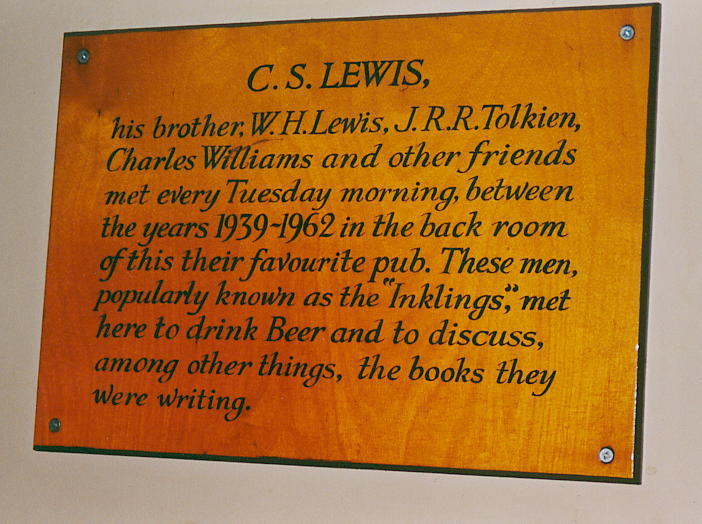
But it did not die out completely. Some authors began taking the elements found in traditional mythology and adapting them to create their own form of mythology. This became known as mythopoeia. And now we get to my favorite part about mythopoeia. Guess who popularized the term? J. R. R. Tolkien. He was part of a marvelous little group called the Inklings. The group was comprised of mainly Oxford professors, and they met on a regular basis to discuss literature. One of the places they frequently met was the pub The Eagle and Child, which has a section dedicated to the Inklings. The other notable member who is directly involved in mythopoeia was C. S. Lewis.


The topic of myth-making was first brought up in a discussion between Lewis and Tolkien. In order to defend his stance on myth-making, Tolkien wrote a poem, titled Mythopoeia, and gave it to Lewis. This poem is what started everything.

The poem was written in 1931. In 1937, The Hobbit was first published and shortly after Tolkien began writing the sequel, The Lord of the Rings. Lewis began writing The Chronicles of Narnia in 1949. And Tolkien's greatest mythopoeic work, The Silmarillion, was published posthumously by Christopher Tolkien in 1977. These are some of the greatest and most popular mythopoeic works. Other works include Star Wars, some comic book characters such as Superman, parts of Harry Potter, and parts of the TV show Battlestar Galactica. As I mentioned previously, the series Rose of the Prophet is mythopoeic as well. Other authors who commonly write mythopoeic works are Neil Gaiman and Robin McKinley.


These authors and works all have noticeable aspects of traditional mythology. Lewis' series is clearly heavily based on Christianity. Tolkien uses Christianity as well as Irish, German, and some Finnish mythology. Not every mythopoeic work has to have a pantheon of gods but many of them do; the gods are a big part of mythology and very easy to transfer. Some mythopoeic works reuse mythological creatures. while others focus more on the important hero's journey. Several mythopoeic works follow the model of the creation myth and depict the creation of the mythopoeic world. One of the most important parts of mythopoeia is the feeling you get when you read one of the works. It's supposed to be fantastical and amazing, and create a sense of wonder. Traditional mythology often had a hidden or obvious message, and mythopoeia is the same way. Think about the things that Lord of the Rings and Harry Potter have taught people, the values and lessons that so many have learned from those stories. That is just as big a part of mythopoeia as the world that the author creates.

Those created worlds are what first drew me to mythopoeia. I love Lord of the Rings, and I am torn between love and hate when it comes to Tolkien. He created such a beautiful world in Middle-Earth, with its own people, history and languages. But it kind of sickens me that he did all that. He's such an over-achiever. Who writes two and a half complete languages and creates an entire history for a world that isn't even real? Tolkien, that's who, and I hate him for it. But I love him for it just as much. I love him so much that I based my entire Senior presentation on mythopoeia just so that I could talk about Tolkien and how brilliant he is (I'm an English Lit major).


There is even a whole society dedicated to mythopoeia. It's called the Mythopoeic Society and is based at Michigan State University. They have Mythopoeic Awards for books and authors that are considered outstanding works of fantasy and myth. There is a scholarly journal as well as a monthly bulletin that talk about different mythopoeic works. I'm kind of in love and would seriously consider becoming a lifetime member if I had an extra $500 laying around.


What I've said here is only a brief overview of what mythopoeia is. And I really can't even begin to describe what the genre means to me. It's such a beautiful thing and so creative. To end, I'll leave you with this excerpt from Tolkien's poem Mythopoeia:
Though all the crannies of the world we filled
with Elves and Goblins, though we dared to build
Gods and their houses out of dark and light,
and sowed the seeds of dragons, 'twas our right
(used or misused). The right has not decayed.
We make still by the law in which we're made.