Monday, July 28, 2014

The Little Friend

SPOILERS. A few months ago, my mom read Donna Tartt's The Goldfinch. She raved about the book and how much she loved it, and shortly after she read Tartt's The Little Friend. She kept telling me that I needed to read both the books and I finally read The Little Friend. What a book! It's one of those books that makes you think and question. It's a long book but so worth the read.


First, I want to talk about Tartt's style of writing. Let me start by mentioning that the book is 555 pages long but has only 7 chapters and a prologue. That makes for seriously long chapters sometimes. On top of that, the perspective jumps from character to character. I actually liked that in this case, though, as there are so many characters and so much happening all at once. It allowed you to see across the board and get to know all of the characters, which is important as the story goes along. I had a little trouble getting used to her writing at first, as some of the sentences were a little disjointed. Also, several of the characters either daydream a lot or get lost in memory, and sometimes you're not sure what is a dream and what is actually happening.

So, what is the story all about? Well, Harriet's brother, Robin, was lynched when he was 9 and she was only a baby. Her sister, Allison, was 4 at the time and outside when it happened but can't remember anything. Robin's death totally destroyed their mother and changed the whole family forever. The story takes place when Harriet is 12 and she desperately wants to know who killed her brother. She starts investigating and gets it into her head that Danny Ratliff, a somewhat friend of Robin's, is the person behind the murder. This sets off the whole story and gets Harriet into a world of trouble.

Harriet tries to get answers out of her sister, Allison, and her grandmother and 3 great-aunts. No one wants to talk about Robin's death, as everyone loved him. His memory has been completely immortalized by the family but they don't like to talk about his death. Once Harriet decides that Danny Ratliff killed Robin, she starts following him with the help of her friend Hely, whose older brother was also a friend of Robin's. And this is where things start to get interesting. It's hard to explain everything that happens in a 555 page novel in only a few paragraphs so I'm only going to touch upon a few things.


The Ratliffs. My goodness does this family need serious help. All of the sons have been in jail, except the youngest who is retarded. The family is basically white trash so they're looked down upon without adding the jail time to the situation. And the grandmother is absolutely crazy. She's mean in a conniving way and eggs her grandsons on, causing fights all the time. Plus, she is constantly "sick and dying" but never actually dies. Farish is literally crazy and was actually institutionalized at one point. He cooks meth, and uses it a little too often, and is beyond paranoid about everything. Eugene is crazy religious and for a time hangs out with a preacher who handles snakes, which plays a major part later on. And Danny is stuck in this family and wants out but can't leave. You believe, like Harriet, that he probably killed Robin. You want him to get caught and get what he deserves. But then you start to know him and realize he actually was friends with Robin and was very upset by his death. But his family beat that out of him and he bragged about killing Robin. In the end, you pity Danny. He's not perfect, but you also don't want Harriet to succeed in killing him.

Which is her plan all along. Harriet wants to kill Danny because she thinks he killed Robin and she wants revenge for the brother she never knew. Although she's the "main character" it doesn't take long to realize that Harriet isn't all right either. Really, no one in the whole novel is. Harriet has no proof that Danny killed Robin but she is adamant that he did and goes to great lengths to kill him. She breaks into Eugene's apartment to steal one of the visiting preacher's snakes, which she and Hely then throw over an overpass onto Danny's Trans Am as it drives by. However, Danny's grandmother is the one driving the car and almost dies. Life lesson: when driving under an overpass in a convertible, beware of falling snakes. Harriet then decides to shoot Danny, which doesn't happen. Instead, he almost drowns her in a water tower, where paranoid Farish had hidden his meth. Harriet manages to escape but Danny, who can't swim, ends up in the water tower. He survives for 2 days, before being rescued and admitting to killing Farish, who he'd shot because Farish was really starting to lose it and Danny wanted to get away.

In the end, Danny is on his way back to prison and Farish is dead. Hely still believes the sun shines upon Harriet and her every deed. And no one suspects Harriet of anything, except epilepsy. The story ends with her in the hospital after having a seizure when she returned home from the water tower incident. The doctors believe she has epilepsy and that's it for her. It's a way to explain away her reaction to the water tower incident, her vomiting and blackout. She almost gets away with murder, expect Danny actually survives and she also begins to realize that Danny and Robin were actually friends and that Danny didn't kill Robin.

Some people don't like the ending. They think that Harriet's epilepsy is a cop out. However, I do think there's something wrong with her because she more than any character had vivid daydreams and seemed to zone out and go into her own world. It seems that Harriet, her sister, and her mother all have a loose grip on reality sometimes. I don't know if Harriet actually has epilepsy but I think there are problems. The other problem people have with the ending is that Robin's killer is never revealed. Honestly, I went into the book expecting that we would never know who killed Robin. How could we? It's been 12 years since his death and no one ever had any clue who did it, so how is a 12 year old girl supposed to figure it out? I think the open ending is part of what makes the book so good and what keeps you thinking about it after you've finished it.

And it really is a good book. It touches upon class issues, between blacks, whites and white trash. It shows you how dark life can really be and how easy it can be to get mixed up in something very dangerous. And while it's a little slow at first, once things start happening they just happen all at once. It's not an easy read, in that the subject material is not always pleasant and the issues throughout the novel are not happy. Death, lynching, murder, drugs, abuse. The novel is dark. But it still captures your attention and doesn't let go.

Saturday, April 19, 2014

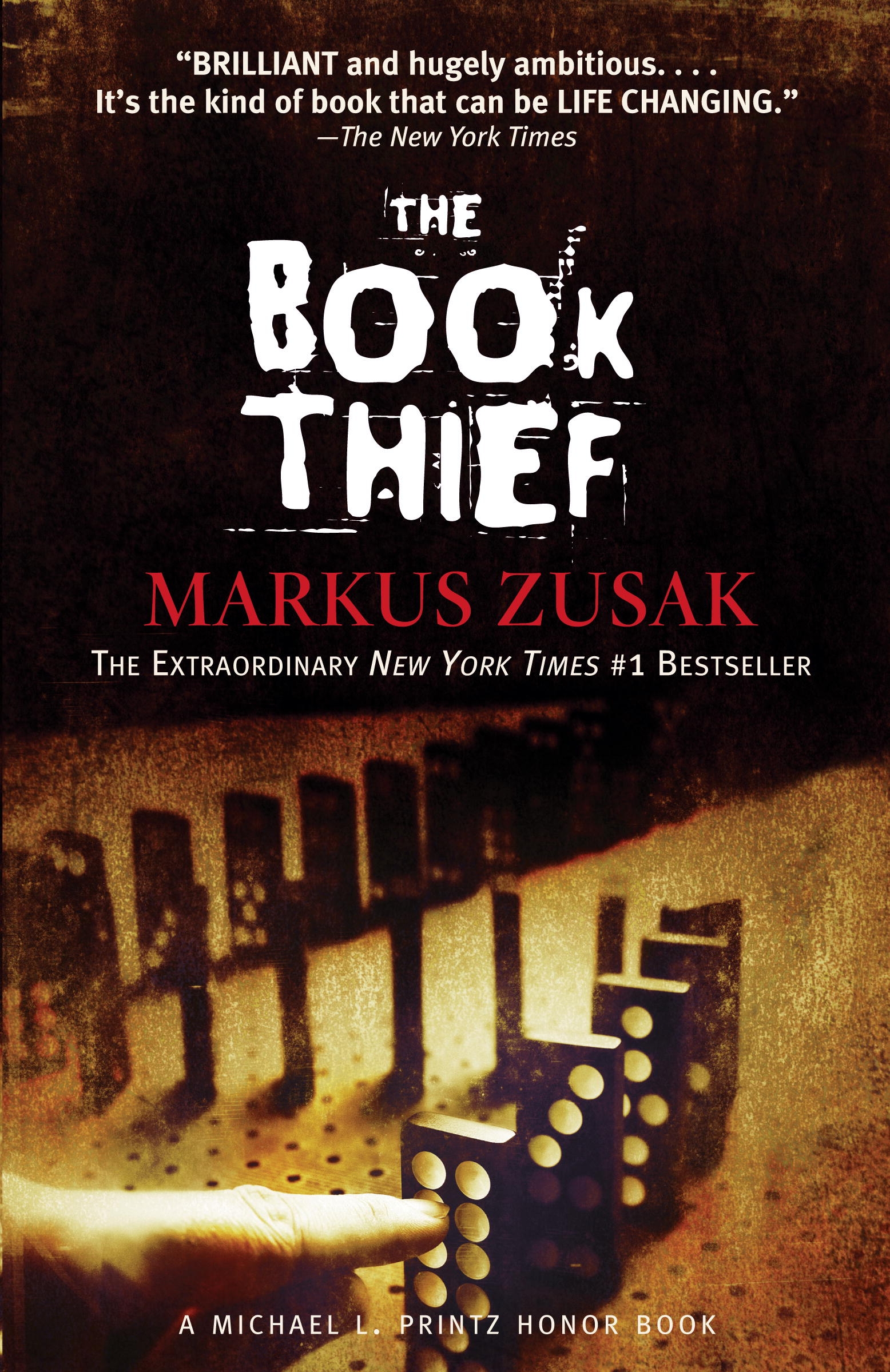
The Book Thief

I've always loved learning about the World Wars. I'm not sure why I find them so fascinating but I do. So naturally, I enjoy reading books set during the wars. I recently read The Book Thief by Markus Zusak and it was incredible. I cried, I laughed, I loved it.


The first thing you need to know about the book is that it's narrated by Death. And he's actually quite funny and personable. He's also very blunt, stating outright that everyone dies eventually. You might think Death would be a depressing narrator but he's not. And if you think about it, death is one of the only guarantees we have in our life. It's only natural that he would be honest. Death tends to jump around in his narration, talking about things out of order. This means that there are spoilers in the book and instead of preparing you for what's to come, they seem to make it worse when you finally get there.

The book takes place in Germany, from 1939 to the end of the war. Liesel is a young girl who is taken to live with Hans and Rosa Hubermann, who are to be her new parents. She becomes friends with the neighbor boy, Rudy Stiener, who has a major crush on her and is always asking for a kiss. The Hubermanns eventually hide a Jew, a young man named Max. He and Liesel become very good friends and she is very upset when he chooses to leave. Liesel is the book thief the title refers to; she steals books and together she and Hans read them. I can't really get into more detail because this is a book that should be read and not spoiled. There is so much and it's so powerful.

The way Zusak writes is so interesting. Each part of the book is titled based on the book that is featured in that section. You can gather from the title of the book that books are important to the storyline. The part titles are The Grave Digger's Handbook, The Shoulder Shrug, Mein Kampf, The Standover Man, The Whistler, The Dream Carrier, The Complete Duden Dictionary and Thesaurus, The Word Shaker, The Last Human Stranger, and The Book Thief.  The book titles are important to what happens in that part. Sometimes you don't realize the significance until the part is over. Zusak also introduces the chapter titles by writing "featuring" and then listing a series of events or topics that are covered in the section. It's very different from your normal novel, which is what makes it so interesting. Throughout the book, Death interjects with little fun facts or pieces of conversation, written in bold and set apart from the rest of the text. In the part The Complete Duden Dictionary and Thesaurus, the interjections are definitions of different words that are important to the story. The parts The Standover Man and The Word Shaker are actually about books that Max writes for Liesel, and The Book Thief is about the book that Liesel writes about her life. Zusak completely wrote the two stories and included them in the novel, complete with illustrations.

A page from The Word Shaker

I won't lie, the book is sad. It's heartbreaking and will make you cry. But it's absolutely beautiful. It's so different from your typical novel about the World Wars. It's through the eyes of Death, who is telling the story through the eyes of a child. And it's about Germans, who are the "bad guys". But Zusak makes these Germans human, capable of pity and understanding. It's a seriously incredible book. One reviewer said "It's the kind of book that can be life changing" and I agree. It's a powerful book about people and the choices they are faced with. As Death says:
"I wanted to tell the book thief many things, about beauty and brutality. But what could I tell her about those things that she didn't already know? I wanted to explain that I am constantly overestimating and underestimating the human race - that rarely do I ever simply estimate it. I wanted to ask her how the same thing could be so ugly and so glorious, and its words so damning and brilliant."

As you probably know, last year The Book Thief was made into a movie. I recently saw the movie, and you can find my thoughts on it here:http://moviegeek92.blogspot.com/2014/04/words-are-life.html

Monday, April 14, 2014

Deerskin

I'm in the English honor society at my school, Sigma Tau Delta (STD and yes, we joke about that). We had a book sale on Saturday, and as you can imagine, the members were some of the first people grabbing books. I was hoping to find something interesting and I certainly did. I was emptying a box and saw Deerskin by Robin McKinley. I immediately grabbed it. I'd been wanting to read it for a while now but the library doesn't have it. So you can imagine how excited I was when I found it.


There is an author's note in the front of the book:
"There is a story by Charles Perrault called Donkeyskin which, because of its subject matter, is often not included in collections of Perrault's fairy tales. Or, if it does appear, it does so in a bowdlerized state. The original Donkeyskin is where Deerskin began." 
And it's quite understandable why the story is not common. It's worse than the original Grimms' fairy tales. One reviewer called the book a fairy tale for adults, which I think is a very accurate description. 

Lissar is the daughter of a handsome king and the most beautiful woman in the seven kingdoms. The people were so enamored of the king and queen that Lissar was fairly neglected. She rarely saw her parents and even her nursemaid was her nursemaid so she could be close to the queen. Then the queen died and people remembered the potential uses of Lissar. She is 15 when her mother dies, and a prince from the sixth kingdom sends her a puppy to help her in her grief. For the next 2 years, Ash is Lissar's closest companion. During these 2 yeas Lissar is trying to decide who she is and who she can be. On her 17 birthday there is a ball in her honor and people realize that she has come to greatly resemble her mother. Including her father, who had promised his wife he would only marry someone as beautiful as she was. He gets the great idea that he's going to marry Lissar four days after her birthday. It gets worse. She locks herself in her room with Ash, refusing to marry her father. On the night they were to be married, her father breaks into her room, almost kills Ash, beats Lissar, and then rapes her. Yep. Definitely a fairy tale for adults.

Lissar and Ash escape the next morning and travel for many days before finding a cabin in the woods. They spend the winter there. Lissar has blocked out any memories of her life before she ran away, which woks until she realizes she's pregnant. The stress and horror cause a miscarriage. She is visited in a dream by the Moonwoman, who takes away her memories and gives her time to heal (you learn later that five years passed during Lissar's dream). Lissar and Ash are also transformed to be unrecognizable; Ash with a longer coat and Lissar with white hair, black eyes, and a white deerskin dress.


Lissar and Ash travel and find themselves, although they don't know it yet, in the country Ash was born in. Lissar gets a job in the kennels, working to save a litter of 6 motherless puppies. She becomes friends with Ossin, the prince who sent her Ash. It isn't until Ossin begs her to attend a ball that she begins to remember who she really is. She's once again horrified and confused. And then at the ball Ossin asks her to marry him. She runs again, taking Ash and the 6 dogs she saved with her. They end up at the cabin again and by the end of winter she realizes she has to return. And she does right as Ossin's sister is about to be married to her father. Lissar and Ash lose their disguises and she reveals the kind of man her father has become. Then she runs again, ashamed of her past, but this time Ossin chases her.
Ossin: "I let you leave me the first time because I thought that was what you wanted - that what you wanted didn't include me."
Lissar: "I do want you. But it does not matter. I am...not whole. I am hurt...in ways you cannot see, and that I cannot explain, even to myself, but only know that they are there, and a part of me, as much as my hand and eyes and breath are a part of me."
Ossin: "I do not believe there is anything so wrong with you. You are fair in my eyes and you lie fair on my heart."

Once again, McKinley has written a wonderful novel. However, I have never despised one of her characters as much as I despise Lissar's parents and the people of their kingdom. McKinley just has a way with words that I love. And it doesn't hurt that Deerskin takes place in the same world as The Blue Sword, which I adore. I loved McKinley's foray into fairy tales for adults. We need fairy tales just as much as children do, and whether she is rewriting existing fairy tales or creating her own, McKinley has a gift for fairy tales.

Wednesday, April 9, 2014

One Amazing Thing

As an English Literature major I do a lot of reading. I don't like all the authors or works we read. In fact, some of them I rather hate. But sometimes, I'll really enjoy an author we read. When that happens, I'll look up the author and see what else they have written, and then I'll check to see if those books are at the library. I've expanded my reading horizons a lot by doing this.

One of the authors I enjoyed is Chitra Divakaruni, an Indian-American author. Her works take place in both America and India, and are exotic and exciting. I recently read her novel One Amazing Thing. The novel is about a group of nine people who get stuck in an underground office after an earthquake. Everyone begins to freak out because they don't know if they'll ever be rescued. One of the people suggests that everyone tell a story from their life, a story about one amazing thing that's happened to them. Each character tells their story in a different way. Some are first person, some third, some a combination. All of the stories deal with India in some way. The office they are stuck in is at a visa office at an Indian Consulate in America.


The people in the office are Jiang, a Chinese woman who grew up in India; her granddaughter Lily, who is quite gifted with the flute; an ex-soldier named Cameron who grew up in the ghetto; a young Muslim man named Tariq who is having issues adjusting to America post-9/11; an Indian-American girl named Uma who is in college; an elderly married couple, Mr. and Mrs. Pritchett, who have been having issues since Mrs. Pritchett tried to kill herself; the receptionist, Malathi, who distrusts men, even though she likes her married boss; and Mangalam, the man who runs the visa office.

They each tell their story and all of them are heartbreaking. All of their stories deal with loss and love, with a struggle to do what's right versus what they want. I think Jiang's is one of the saddest, although Mr. Pritchett and Mangalam both have stories that are rather sad as well. Malathi's story is probably the most cheerful and the funniest. I would not want to be in any of their shoes, either in their stories or in the office after the earthquake.

I love the way that Divakaruni wrote the novel. She begins before the earthquake and lays out the landscape. We follow the characters through their thought process about what to do and how to survive long enough to be rescued. She doesn't have the stories follow one after another. Instead, she interjects the stories in the action, so you go from a story back to the office. It's rather like Canterbury Tales, which the character Uma is reading in the office before the earthquake hits. I think it was very well written and really conveyed the fear that people have during a situation like that. People were lying and hoarding things at the beginning, but as they all connected they began sharing with each other.


How does the story end? Do they get rescued? Well, I wouldn't want to spoil the ending. And even if I wanted to, I couldn't. Divakaruni ends the novel on a cliffhanger. Uma is just about to end her story and they can hear people moving around upstairs. And the story ends. That's it. It's frustrating and maddening, and brilliant. If I was ever an author, I would write endings like this, ones that are incomplete and leave everything open. They're cruel and unusual, but they make a point. And in a story like this, where the characters are hoping they will be rescued and not die, leaving the ending open is perfect. Would you rather know they were never rescued and died, or would you like to hope they were found on time?

Wednesday, April 2, 2014

The Freedom (or Catteni) Series

I haven't read much science fiction. I watch a lot of science fiction movies and TV shows but I find it difficult to read science fiction books. I get confused with all the different kinds of spaceships, and technical and science jargon. So I tend to avoid most science fiction. Occasionally though, I will find a series (as science fiction is almost always written in series instead of singular books) that I really like and find easy to understand.

My parents recently got really into audio books and listen to them on their way to work. My dad decided to get some Anne McCaffrey books and choose the Freedom Series. On the days I went in to work with him and he was listening to an audio book, I took a book of my own and read during the drive. It worked pretty well, until I heard one of the voices in the series. The character sounded like a Nazgul (the few times you hear them speak) or Emperor Palpatine talking through Vader's helmet. Needless to say, I was intrigued and decided to read the books, which I did this weekend (the series made up four of the eleven books I read).


The series is called both the Freedom Series and the Catteni Series. Freedom because each book has the word "freedom" in the title and the concept of freedom is very important to the story, and Catteni because the Catteni are the alien race that have attacked Earth (or Terra, as they call it). The series was published beginning in 1995 with Freedom's Landing, followed by Freedom's Choice in 1996, Freedom's Challenge in 1998 and Freedom's Ransom in 2002.


As I mentioned, an alien race called the Catteni have invaded Earth. They are humanoid, with grey skin and yellow eyes. Their home planet has a denser gravity than Earth and the other planets in the series, so while they are bulkier than humans they can move quickly. The Catteni have rounded up thousands of humans and taken them from Earth to become slaves. The story begins with Kris Bjornsen on Barevi, a merchant planet with a slave market. Kris inadvertently saves a Catteni man, and together they are captured and dropped on an uncivilized planet. This is a common practice of the Catteni to see if a planet is habitable. Throughout the first novel, the people dropped adjust to their new surroundings. They name the planet Botany and begin making it a home. Zainal, the Catteni, becomes a huge asset to the humans and other alien races and is a major reason they survive. Kris also finds herself falling for him and they begin a relationship.


The rest of the series describes the struggle of the Botanists to regain their freedom. Through Zainal, they learn that the Catteni are just as much victims as the other alien races. They are controlled by the Eosi, our Nazgul sounding friends from earlier. Zainal, Kris, and the other Botanists slowly steal spaceships from the Catteni and begin a rebellion against the Eosi. They manage to kill the Eosi and free Earth, Botany and Catten (the Catteni home planet) from Eosi domination. In the last book, Zainal leads a group from Botany to Earth and then to Barevi to help restore order and regain materials stolen from Earth.


I really liked the series. I loved the description of Botany and the ingenuity of the humans in adapting to their surroundings. I thought it was interesting that the Catteni were just as much victims as the humans and other alien races. I think having the bad guys being controlled by even bigger bad guys was smart and different. I also appreciated the difference in how Catteni raise their children versus how humans raise their children. Not to mention how amusing it was reading about Zainal slowly learning English and then seeing him correct a human's English later. And even though there were a lot of people moving in and out of the series, it was easy to keep track of everyone and like certain people better than others. Not all of the humans were likable either, which was realistic and showed that even after being invaded by aliens some people will be creepers.

For the first major science fiction series I've read, it was easy to read and understand. And it really was very good. What I like so much about fantasy is that it's magical, even if there isn't magic in the story. And since science and magic are at such odds with each other, science fiction doesn't tend to be magical the way fantasy is. But I found the Freedom Series to be magical in a way. Even though there were spaceships and travel between planets, there was still a fantastical element to it. It was certainly more believable than fantasy; it's easier to believe in an alien invasion than in magic wands. And I enjoyed that even through an alien invasion and against tremendous odds, humans fought back and won. It just goes to show what resilient beings we are.

Monday, March 31, 2014

How I Define a "Good" Book

My computer died on Thursday (for the fourth time in five months) so I've spent most of the weekend reading. I read 11 books from Wednesday to Sunday. That's a lot in such a short time even for me. And it was a wide range of books and authors. Nine of the books were ones I hadn't read before and they were, for the most part, alright. There was a series of four books I read that was really good, but none of the books I read are my new favorite. Which got me thinking about how I decide a book is one of my favorites. What is it about a book that makes it better than others?

It's the feeling I have when the book is over. That's the first clue. I have one of two responses when I finish a book. The first is "Oh, that's the end. Well that was a good book. It was enjoyable. Now, what else do I have that I can read?" I feel indifferent at the end (or on rare occasions, I absolutely hated the book and never want to see it again). The second response is "It's over. It's over? But what now? Maybe I should read it again. No, I have other things to read. But none like this so I should read this again. Well, I could try reading this but it's not quite right. Neither is this. Hmm maybe I have a movie that's similar?" THAT is the response I'm looking for.


When I finish a truly good book, I feel like something is missing but I also feel complete. It's a paradox, an oxymoron, and a simply beautiful feeling. I can look back on the book and I know it is something that I could read a hundred times and never get tired of.

The funny thing is, almost all my favorite books are ones that I had to force myself to read at first. They are either written at a different time so I have to adjust to the language, or they start slow and  I have to tell myself it will be worth it if I just keep reading. It's still that way. Of my 10 favorite books, only 2 are ones that I can pick up and start reading with no trouble. And both of those are marketed as children's books (Harry Potter and The Chronicles of Narnia). The other 8 are all books from a different time period or are a little slow at the beginning (The Lord of the Rings, Pride & Prejudice, Jane Eyre, The Blue Sword, Life of Pi, Jurassic Park, Island of the Blue Dolphins, and World War Z).

All 10 of my favorite books evoke that feeling of loss and completion. It's a bittersweet feeling and I honestly do consider reading the book again immediately after I've finished it. It's amazing I read as many new books as I do instead of just rereading all of my favorites. At least for the books with movie adaptations (good ones, that is) I have some way of relieving the feeling.


But it's not just the end result. I should be able to look back at a book that I really liked and pick it apart. I liked this, I didn't like that, this quote was amazing, I cried here. Something in the book produced the feelings I have at the end and I should be able to pinpoint it. And then I use that to find other works that are similar. For me, reading is an enjoyable experience. It's an escape, a way to relax, and a way to dream. I get lost in a truly good book and have to reconnect with reality. That's why I read. That's what I'm looking for in a good book.


Tuesday, March 25, 2014

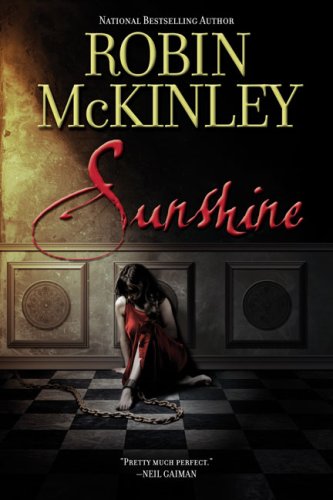
Sunshine

One of my favorite books, The Blue Sword, was written by Robin McKinley. For a while, it was the only book of hers that I had read but I've slowly started reading more of her works. The latest book I read by her is Sunshine. It won the Mythopoeic Fantasy Award for Adult Literature in 2004, which gives me even more reason to love the book.


The story takes place in a world very much like ours but with one minor change: there are zombies, vampires, weres of many different animals, succubi and demons. Collectively, they are called Others. The story is set after the Voodoo Wars, which were between humans and the Others. Magic plays a big part in the story and there are many bad spots, or places where black magic thrives.

The main character is a young woman whose name is Rae but is nicknamed Sunshine. She is a baker at her stepfather's coffee shop. One evening she heads out to her family's old cabin by the lake and is abducted by vampires. This changes her life. She is chained to the wall in a ballroom but she is not the only prisoner. A vampire named Constantine is also being held and she's supposed to be a treat for him. Sunshine manages to escape by turning the knife she hid in her bra into a key. She also frees Con and they leave together, in the daytime. Sunshine is able to keep Con from bursting into flames from the sun if they are touching.


The rest of the book takes place over the next six months. Sunshine has to explain why she was missing without saying it was vampires and without mentioning that she freed a vampire. She and Con have formed a bond that could threaten both their lives if anyone from SOF (Special Others Forces) found out. Sunshine has to deal with her magical heritage and the knowledge that there are more partbloods (part human-part demon) around her than she originally thought.

The novel was very good. I love McKinley's works and her style of writing. Sunshine was a little different, as it was from Sunshine's point of view and was very honest and open. It gave the whole situation a touch of reality: this is how someone really feels when their world is stripped away from them. Like most of McKinley's other works, the book was a little slow at the beginning. But once it took off, it just kept going. McKinley frequently creates new worlds or worlds that look like ours but with a slight difference, and her books usually start right in the middle. As the story goes, she'll explain things here or there to catch you up. Sometimes this makes things really confusing but that was not the case here. I found everything easy to follow and understand.


And as far as vampire novels go, it wasn't a cheesy romance or some sort of erotic thriller. The Others were handled very well and the vampires were not appealing. Sunshine frequently thought about how awkward Con was and how different he was from humans. She never saw him as blindingly attractive and I'm honestly not sure she ever thought he was attractive. I actually have a quote describing the antagonist, a master vampire who is not physically seen until the very end of the book. What I like about the following quote is how disgusting McKinley makes him sound.

“I said that monster doesn’t cover it. There is no word for a several-hundred-year-old vampire who has performed every available wickedness over and over till he has to invent unavailable ones because he’d worn the others out. His flesh was not flesh; it was a viscous ooze, held together by malice. His voice was a manifestation of malignancy, for he had no tongue, no larynx; his eyes were the purest imagination of evil: flawless in a way that flesh could never be.” 

There are two other quotes that I want to leave you with. The first is a rather charming description of what you feel like after killing several vampires. Again, it's disgusting but I love the imagery that McKinley uses.

“I wish I could forget how it feels, your hair stuck to your skull with blood, foul blood running gummily down inside your clothes, invading your privacy, your decency, your humanity, till it chafes you with every breath, every movement, the tug of it as it dries on your skin feeling like some kind of snare. Blood in your mouth, that you cannot spit the vile taste of away.”

And the last quote. I love the contrast that McKinley creates between opposites. I love that such a surprising element is possible, as I myself love lying in the sun. And I just love the last line. 

“The hierarchies of magic handling are no particular study of mine. But your particular affinity is for sunlight: your element, as it were. It is usually one of the standard four: earth, air, water, fire. Sometimes it is metal, sometimes wood. I have never heard of one for sunlight before, but there are—are tests for these things. Yours is neither fire nor air, but a bit of both, and something else. While I was doing the tests and coming up nowhere, I thought of sunlight because of all the days I have seen you lying in the sun like a cat or a dog—I have only ever seen you truly relaxed like that, lying motionless in sunlight. And you told me once about the year you were ill, when you lived in a basement flat, and how you cured yourself by lying in front of the sunny windows when you moved upstairs. I thought of your nickname—how I myself had relied on your nickname to tell me the real truth about you, after the vampire visited you….As for your—let us call it counteraffinity: your counteraffinity may be for vampires. I have never heard of this either, but I do know it is often a magic handler with a principal affinity for water who can cross a desert most easily; a handler with a principal affinity for air who can hold her breath the longest, someone with an affinity for earth who flies most easily. It is the strength of the element in you that makes you more able to resist—and simultaneously embrace—its opposite. You are not consumed by the dark because you are full of light.”